
Why bond yields move the way they do
When sellers show up, yields go up. When buyers show up, yields go down. Here’s why.

What you’re watching
You’re watching a bond being repriced by market forces in real time.
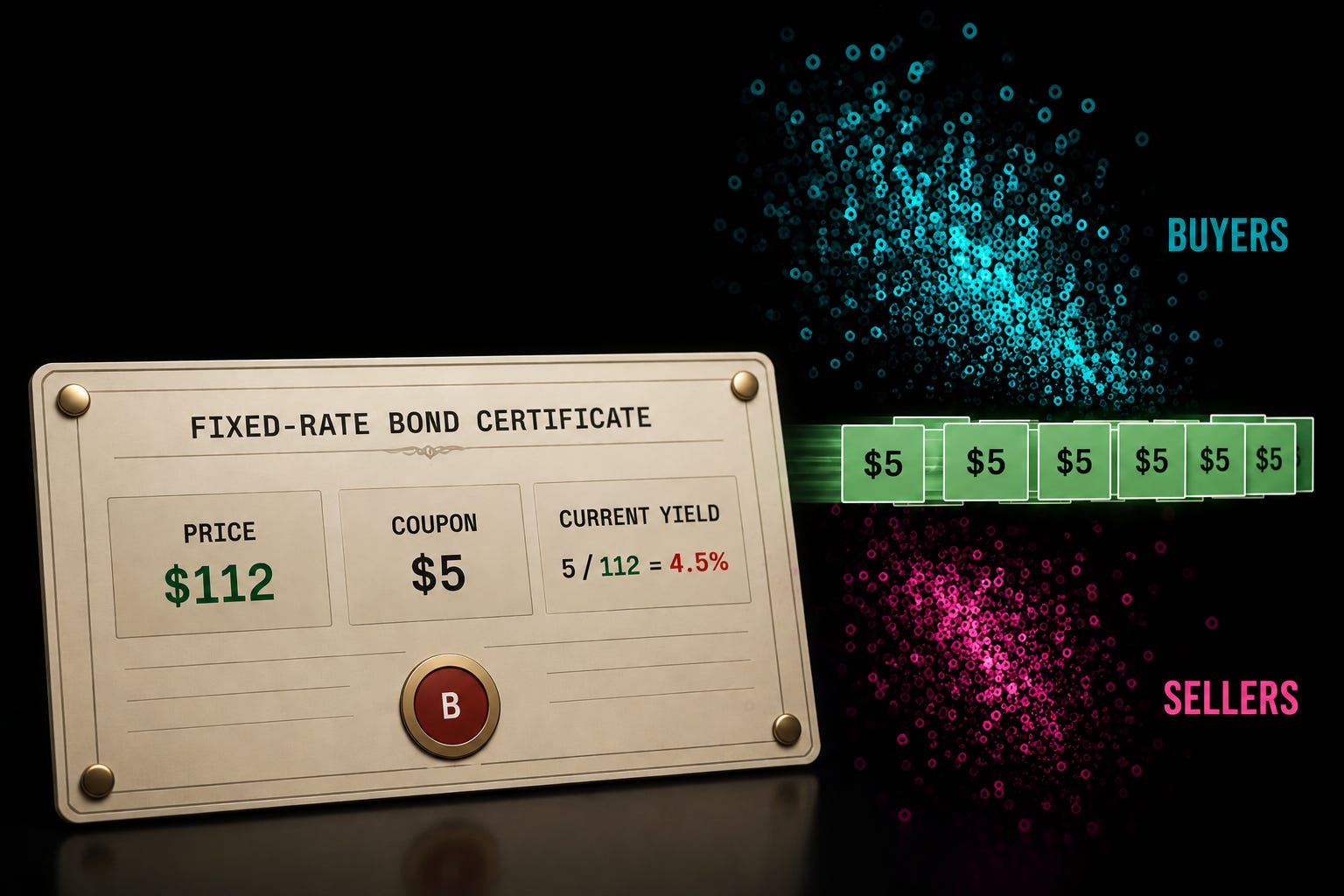
The bond is represented by the certificate on the left. It pays a fixed coupon of $5; you can see the bills coming out of the slot on the right side of the certificate. That payment never changes. What changes is the price that buyers and sellers agree to trade the bond at.
Market participants are represented by the hollow circles. Teal circles are buyers, pink circles are sellers. At first the crowd is balanced — equal buyers and sellers, price sits at $100, and the yield (which is just the $5 coupon divided by the $100 price) is exactly 5%.
Then more sellers start arriving. With more people wanting to sell than buy, the price falls to $95. The bond still pays $5. But $5 divided by $95 is 5.26%, not 5%. Yield went up simply because market participants are more eager in getting rid of the bond than people are to buy it.
However, we then see buyers push back. Price climbs to $105. Same $5 coupon, higher price: yield falls to 4.76%.
Then a large wave of sellers floods in and the price collapses to $50. Yield spikes to 10%. Finally, an even larger wave of buyers rushes in — sellers thin out — and price rockets to $150. Yield falls all the way down to 3.33%.
Market participants move the price, and price moves the yield.
One simplification to flag: the animation uses current yield, which is simply coupon divided by price. In practice, markets quote yield to maturity (YTM), which also accounts for the fact that a bond eventually returns its face value at maturity — so buying at a discount or a premium affects your total return too. The YTM has no closed-form solution and is solved numerically. But the direction is always the same as current yield: price up means yield down, price down means yield up. Current yield is a good enough approximation to make the point.
What this means
Bond yields are not a feature of the bond itself. They are a consequence of the price buyers and sellers agree on. “Yields rose” just means the bond got cheaper. “Yields fell” just means it got bid up.
This is why central bank decisions, inflation data, and credit events move yields without changing a single line of any bond contract. They shift the crowd. More sellers, lower price, higher yield. More buyers, higher price, lower yield.
The most common forces that drive that crowd:
Inflation rises — inflation erodes the real value of a fixed $5 payment. Holders sell to get out of a shrinking return, price falls, yield rises. Central banks often raise interest rates in response, which makes new bonds pay more, making existing lower-coupon bonds even less attractive and pushing their prices down further.
Inflation falls or recession hits — investors expect rate cuts and rush into bonds to lock in current yields before they disappear. Buyers flood in, price rises, yield falls. Bonds also become attractive as a safe haven when equities sell off, amplifying the buying.
Credit risk increases — if there’s doubt about whether the issuer can actually make the coupon payments, sellers dump the bond regardless of rate conditions. Price collapses, yield spikes. This is a risk premium: the yield has to be high enough to compensate for the chance you don’t get paid at all.
Central bank policy shifts — when a central bank signals higher rates, newly issued bonds will carry higher coupons, making existing bonds with lower coupons less competitive. Sellers show up immediately, ahead of the actual decision. When the bank signals cuts, the reverse happens — buyers front-run the move.
Flight to safety — during market panics, government bonds in particular get bought aggressively because they’re perceived as the safest asset available. Yields on those bonds can fall sharply even with no change in fundamentals, purely because scared money is crowding in.
Thanks for your article.
Just as you describe: At the end of the day, its all about supply and demand in the short term.
However, two beacon of Hope for all fixed income Investors suffering at the moment:
1. Holding Bonds to maturity helps ;)
2. Even as Bonds loose value due to Higher nominal Rates, those Higher Rates will also give you Higher Returns when you buy more ;). So there is some relieve as yields of reinvestment increase.