
What “priced in” actually means
And how being a contrarian at the right time can pay off massively

Everyone uses the phrase. A Fed cut is “priced in,” good earnings were “already priced in.” Almost nobody stops to explain what it actually means, which is that the crowd moved before you got there, and there’s no much profit left for you if you’re right and aligned with consensus.
What you’re watching
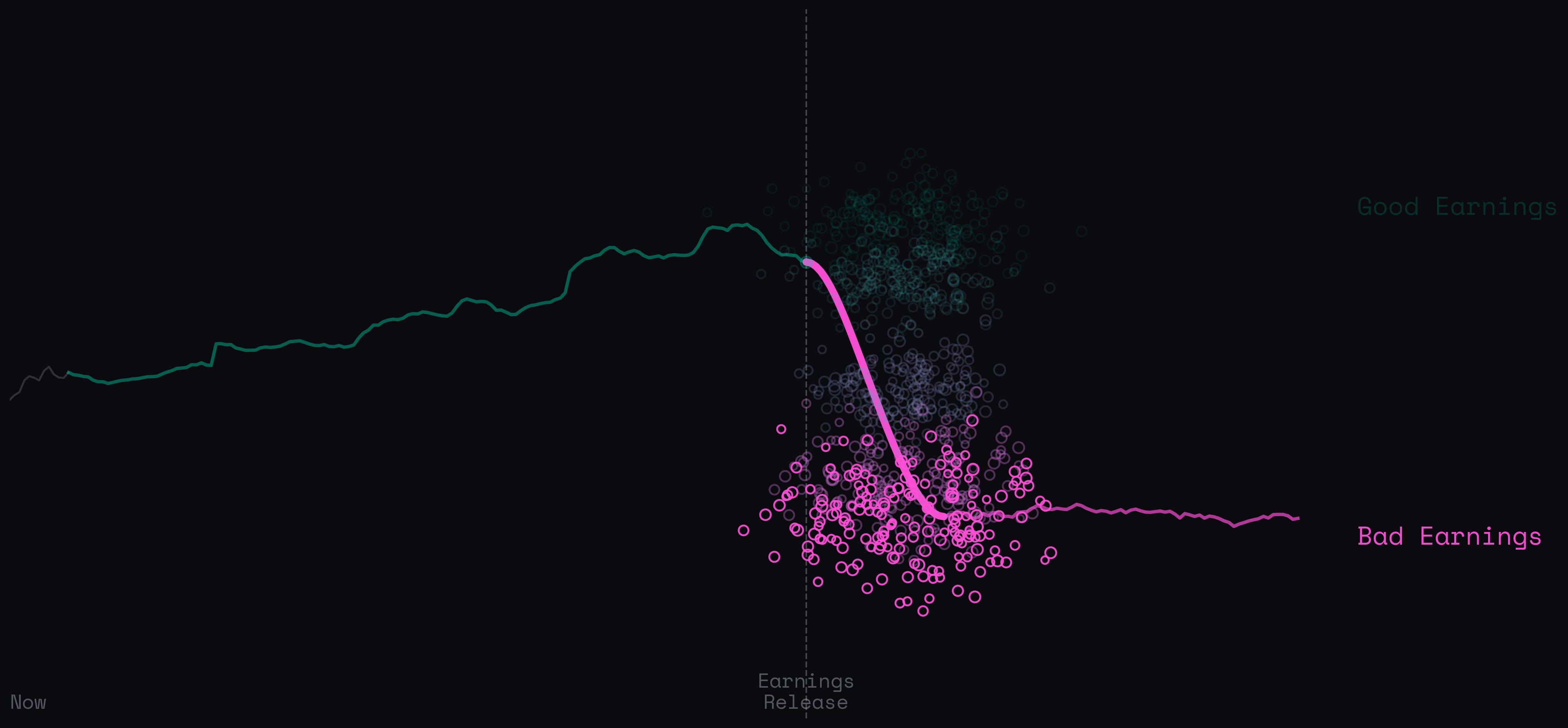
You’re watching the price of a stock being moved by market expectations before the earnings release date.
Market participants are represented by the hollow circles you see floating around the 2 possible outcomes “Good Earnings” and “Bad Earnings”.
At first there is a split in expectations, with some participants expecting a good outcome, and some participants expecting a bad outcome.
Then some piece of news comes out, an analyst recommendation perhaps, or the CEO appearing on TV hinting at good results. You can see market participants start crowding around the good outcome expectation, and the price starts to drift higher.
After a second round of rumours on good results, most of the participants are now expecting a positive earning release.
When the earnings are actually worse than expected, or straight out bad, consensus rushes to sell their position, causing a large price drop.
What this means
When evaluating whether to buy shares of a company (or invest in any other asset), not only the investor has to think whether their thesis is right or wrong, but also what the market consensus is. Using the earnings release example, if an investor expects good earnings for company X, then they will wish to buy shares, as its stock price should increase to reflect fundamentals. However, the stock will not wait for the earnings release day to “update” its price, but will often move before, pushed up by “smart money”, which usually start accumulating a position way before the release date. This means 4 things:
If the investor is right and consensus, then there may not be much left to profit from a good earnings release repricing, unless the investor was very early and positioned before good rumours about the earnings
If the investor is wrong and consensus, then that hurts, because when bad earnings come out there will be a disproportionate amount of aggressive sellers with respect to buyers, as consensus rushes to unload their position
If the investor is wrong and not consensus, then they might have entered a short position expecting a bad earnings release, and bled money depending on how early the short was entered before the good earnings release
If the investor is right and not consensus… well this is where the money lives. As you saw in the animation above, when the market is wrong it has to reprice down both fundamentals AND expectations, producing a sharp drop, often creating a gap. There’s a catch though: if the investor opens their short position too early, then the initial uptrend driven by expectations might have caused them large losses, and even force them to cover their shorts before the earnings release date.
This is why we hear about phrases like “Markets can remain irrational longer than you can remain solvent”, or “In the short run, the market is a voting machine but in the long run, it is a weighing machine”.